
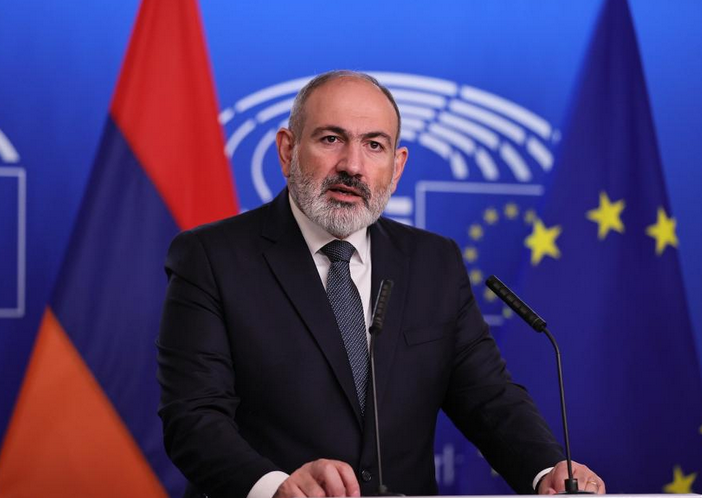
2026 is shaping up to be a significant electoral year. Following swiftly behind Hungary’s parliamentary election, which saw opposition leader Peter Magyar defeat Putin ally Viktor Orban, comes another critical vote-this time in Armenia. Due to be held on 7th June, it will take place against a complex backdrop of peace negotiations with Azerbaijan, church-state conflict and geopolitical recalibration, as in recent years, the post-Soviet state has distanced itself from its strategic partner Russia. This is significant because, at a time when Moscow’s influence in the South Caucasus has waned, the Kremlin will view Yerevan’s upcoming parliamentary election as an opportunity to reassert dominance in the region. The vote’s outcome will determine whether the current Armenian prime minister Nikol Pashinyan will remain in power and continue the peace process and diversification of his country’s foreign policy, or a pro-Russian opposition party takes over, which could disrupt peace efforts and return Armenia to Russia’s orbit.
The Nagorno-Karabakh conflict
In order to understand the current political situation in Armenia, it is necessary to look back at the country’s decades-long conflict with Azerbaijan over the Nagorno-Karabakh region. In the early 1920s, Soviet Russia invaded the South Caucasus and, in an example of Stalin’s divide-and-rule strategy, declared that Nagorno-Karabakh, with its 95% ethnically Armenian population, would be an autonomous oblast within the Azerbaijan Soviet Socialist Republic. When the Soviet Union began to collapse, tensions in the region boiled over into a full-scale war between Armenia and Azerbaijan. The First Karabakh War (1988-1994), as it is known, was won by Armenia, and the country consequently gained control of Nagorno-Karabakh and some of the Azerbaijani territory surrounding it. This was difficult for Baku to accept, and in the years following 1994’s Russia-brokered ceasefire, there were intermittent clashes between the two sides. War broke out again in 2020, and Azerbaijan, with Turkey’s support, seized part of Nagorno-Karabakh. After six weeks of fighting, Moscow again brokered a peace deal, under which Azerbaijan regained control of the districts adjacent to Nagorno-Karabakh, and also a large part of Nagorno-Karabakh itself. The agreement also established the Lachin corridor, a small strip of land that would connect Armenia to Nagorno-Karabakh and be monitored by Russian peacekeepers. There were periodic violations of the ceasefire, and In 2022, Azerbaijan blocked the corridor, which caused food and fuel shortages in the territory. Just as it seemed that the crisis was easing, in September 2023, Baku launched a lightning offensive in Nagorno-Karabakh and seized control of the entire region. Almost all of the approximately 100,000 Armenians remaining in the disputed territory fled to Armenia as refugees. Following the dissolution of Nagorno-Karabakh, Azerbaijan and Armenia entered peace talks.
Armenia-Russia relations
For most of the post-Soviet era, Armenia has maintained close economic, military and political ties with Russia, but that began to change in 2018 when Nikol Pashinyan peacefully overthrew former president Serzh Sargsyan, in what is known as the Velvet Revolution. In 2023, relations between the two countries deteriorated significantly when Armenia appealed to the Russia-led Collective Security Treaty Organization (CSTO) for support as Azerbaijan attacked Nagorno-Karabakh, and despite the presence of its peace-keeping troops in the region, the Kremlin declined to intervene. This failure to act has caused the Armenian people to feel a great deal of bitterness towards Russia, and Pashinyan’s government to reassess the value of being in Moscow’s orbit. Since then, it seems that the prime minister has been reorienting his country’s geopolitical posture towards the West, although Armenia is still reliant on Russia for energy and an export market. In 2024, Armenia froze its CSTO membership, and in 2025, its parliament passed legislation to initiate the process of joining the European Union. It also began importing arms from India and France, instead of Moscow, and removed Russian border guards from Yerevan’s airport and the Armenian-Turkish border. The end of the conflict with Azerbaijan, and with it Moscow’s role as security guarantor to Armenia, has meant that Yerevan has been able to diversify its foreign policy away from Russia. The country’s strategic partnership with America has grown after last year’s Washington summit between Armenia, Azerbaijan and the US resulted in the initialing of a peace agreement between the two South Caucasus countries and the establishment of the Trump Route for International Peace and Prosperity (TRIPP)-a corridor designed to link Azerbaijan with its exclave Nakhchivan in Armenia, and also form a new segment of the Middle Corridor transport route linking China and Central Asia to Europe. The deal is being seen as a diplomatic success for the US, and it is also a triumph for Pashinyan, whose ‘Real Armenia’ election campaign is based on the tenets of lowering dependency on Russia and normalizing relations with traditional adversaries Turkey and Azerbaijan, as well as reopening the country’s borders.
Why is Armenia important to Russia?
Russia’s influence over the post-Soviet states has declined since it invaded Ukraine in 2022, as the war has demanded much of its focus and has alarmed the countries that used to be ruled by Moscow. However, the South Caucasus remains strategically important to the Kremlin, and with Armenia acting as a crucial foothold in the region, Russia does not want to let it slip from its grasp. Bordering Turkey and Iran, Armenia has provided a platform from which Russia has been able to manage its relationships with the regional powers. It also hosts a Russian military base at Gyumri, which allows the Kremlin to have a military presence in the South Caucasus and near the Turkish border. Due to its membership in the Eurasian Economic Union, Armenia has also been able to serve as a transit hub for exporting sanctioned Western goods to Russia.
Why is Russia threatened by the prospect of peace?
For decades, Moscow has skillfully exploited historical grievances and mutual suspicions to manipulate all three South Caucasus countries, and as a result, their foreign policies have been conflict-centered, which has given the Kremlin disproportionate power and leverage. Conflict allows Russia to maintain a military presence in the area and interfere in the countries’ political affairs. In the case of the Nagorno-Karabakh dispute, Moscow has acted as a security guarantor, arms dealer and mediator for both Armenia and Azerbaijan, leaving them dependent on Russia. Pashinyan has realized that peace with Azerbaijan is the only way to break the cycle, remove Russia’s leverage and free Armenia from its meddling. For Russia, this would lead to a further loss of influence over the country and the South Caucasus in general. If that were not bad enough for Moscow, the involvement of the West in the peace process, and in particular the US usurping Russia in its role as the main mediator in the region, will also be of great concern. Russia sees Armenia becoming closer to the West as the West expanding its influence in South Caucasus-a highly desirable region for global powers due to its strategic geopolitical location and energy resources. Whereas once Yerevan was a guaranteed ally, Moscow now sees Armenia as a hybrid battlefield where it is fighting against the West, and the upcoming election is a chance to score a victory and regain its place as the dominant military and security player in the region.
Opposition force: the Armenian Apostolic Church
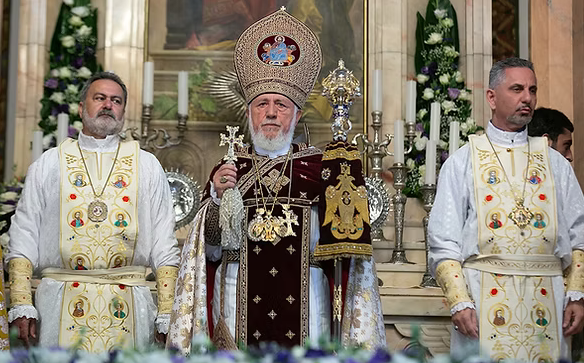
The opposition political parties running against Pashinyan in the election are, for the most part, weak and unpopular, and although the prime minister’s own approval rating has dropped sharply since he came to power, recent opinion polls show that his Civil Contract party is currently leading the election race. However, two opposition forces have emerged that could change that, and one of them is the Armenian Apostolic Church (AAC). Although Armenia is a secular state, the AAC is one of the pillars of the country’s society. It is seen as a symbol of national identity and is the deeply religious nation’s most trusted and respected institution. Almost as soon as Pashinyan took office, tensions arose in the relationship between the Church and the government after the prime minister did not intervene when a civic movement emerged which made a number of serious allegations of misconduct against the head of the AAC Catholicos Karekin II. Relations worsened following the 2020 Second Karabakh War, when Karekin joined calls for Pashinyan to resign, and matters escalated further in 2023 when Baku retook Nagorno-Karabakh. The Church is critical of the concessions that Pashinyan has made in his efforts to secure peace with Azerbaijan and normalize relations with Turkey, claiming that he has capitulated to Baku and his actions are a threat to Armenia’s national identity, security and territorial integrity. The prime minister has responded by accusing Karekin of breaking his vow of celibacy and demanding that he be removed from his post as head of the AAC. In 2024, Archbishop Bagrat Galstanyan, with Karekin’s backing, led major anti-government protests against the government’s territorial concessions to Azerbaijan. Galstanyan was later arrested on charges of plotting a coup, and several other members of the clergy have since been detained on similar charges as part of the government’s crackdown on what it sees as illegal political activity within the Church.
Pashinyan and his government believe that the Church is operating as a pro-Russian opposition force and that Moscow has been working behind the scenes to exploit the rift between the two sides. The prime minister has called the clergy a ‘criminal-oligarchic’ network and alluded to a report by Armenia’s security service which stated that Karekin’s brother Archbishop Ezras Nersisyan was recruited by the KGB in the 1980s. It is true that the AAC’s leadership has historically maintained close ties with the Russian Orthodox Church and the Russian state, and the same can be said now: in 2025, Putin awarded Archbishop Ezras, the head of the Armenian Diocese of Russia, the prestigious Order of Alexander Nevsky for his part in strengthening relations between the Russian and Armenian nations. Karekin was given the same honor in 2022, and Russia’s Foreign Minister Sergey Lavrov has come out in support of the AAC and called the government’s actions ‘unjustified’.
Religious institutions have long functioned as important channels of soft power for Russia in its near abroad. Through them, Moscow is able to reinforce cultural ties, control political narratives and maintain influence even when its military and diplomatic sway has diminished.
How does the rift between church and state benefit Russia?
The conflict between Pashinyan and the Church’s leadership has turned personal, and It is having a detrimental effect on Armenia’s public discourse and contributing to polarization within its society. This is exactly the sort of chaotic situation that the Kremlin seeks to create, as it undermines the country’s cohesion and makes it difficult to mount a unified opposition against pro-Russian interests. In this instance, Pashinyan’s rhetoric has fallen below the standards of dignity expected of government communications, and the Church has abandoned the neutrality expected of it by becoming involved in politics, which may lead to the public becoming disillusioned and losing trust in its institutions. This is known to be the primary reason for the rise in populism.
Opposition force: Samvel Karapetyan and Strong Armenia
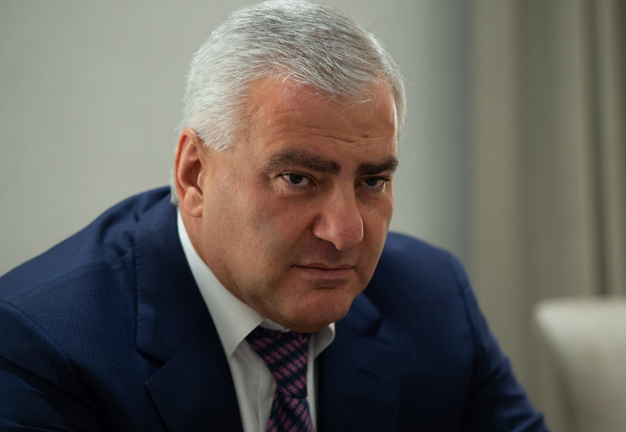
In June 2025, billionaire Russian-Armenian businessman Samvel Karapetyan arrived in Yerevan to defend the AAC. He issued a public statement of support, after which he was detained by the Armenian authorities on the basis that his words were tantamount to inciting a coup. After his arrest, Karapetyan’s supporters created a civic movement called ‘Our Way’, which then evolved into the populist-leaning, pro-Russian political party, Strong Armenia. The party, which was registered in January of this year, is proving to be a major challenger to Pashinyan, and according to opinion polls, is currently in second place behind the Civil Contract party.
Although Karapetyan is still under house arrest in Yerevan, he has been elected president of the Strong Armenia party and nominated as its candidate for prime minister, despite the fact that he does not meet the required citizenship and residency criteria. One of the richest Armenians in the world, Karapetyan moved to Russia in the 1990s where he founded his business empire, the Tashir Group. Despite being based in Russia, he has invested heavily in Armenia and remained involved in the country’s public life. Until his arrest, his company owned Armenia’s main power company, Electric Networks of Armenia. He is also a major donor to both the AAC and the political opposition-in 2021, he financed former Armenian president Robert Kocharyan’s election campaign. He has criticized Pashinyan’s government over the loss of Nagorno-Karabakh, damaging Armenia’s national identity and harming its relationship with Russia, and has pledged that Strong Armenia will strengthen ties with Moscow, oppose the concessions that Pashinyan has made during the peace talks, and deliver a robust economy, as well as national unity.
Up until last year, he had not been publicly involved in politics, which has led some experts to speculate that he may have been ‘inserted’ onto the political scene by the Kremlin. After all, it would not be the first time that Moscow has been suspected of using an oligarch with roots in a former Soviet state to gain influence. Bidzina Ivanishvili, the de facto leader of Georgia, is a prime example. Born in a Georgian village, Ivanishvili made his fortune in Russia in the 1990s, before returning to his homeland in 2003 and becoming one of the country’s most impactful philanthropists. He then established the Georgian Dream-Democratic Georgia party in 2012 and scored a landslide victory against Georgia’s pro-Western former president Mikheil Saakashvili. Since then he has moved Georgia back into Russia’s sphere of influence. At a recent meeting between Pashinyan and Putin, the Russian president made it clear that he is taking an active interest in Yerevan’s political affairs by stating that dual Armenian-Russian citizens, including Samvel Karapetyan, should be allowed to run for seats in the Armenian parliament.
What would a Strong Armenia victory mean for Russia?
Karapetyan and Strong Armenia appeal to voters who are discontented with Pashinyan’s leadership and foreign policy direction, and with Karapetyan’s substantial financial resources and status in Armenian society, they have the potential to win the election. This is a desirable result for Moscow because it would likely mean a warming in relations between the two countries and an end to the peace deal between Yerevan and Baku. In all likelihood, a pro-Russian government would revive the conflict over Nagorno-Karabakh, and Moscow would be able to use it as a way of keeping Armenia and Azerbaijan dependent and divided again. It would also be the end of TRIPP and the US presence in the South Caucasus, which would allow Russia to reclaim its role as the main power broker in the region and halt what it sees as the creep of Western expansion.
A hybrid campaign
According to Russian newspaper Vedomosti, Putin’s First Deputy Chief of Staff Sergei Kiriyenko is overseeing influence operations in Armenia, as he did with the recent elections in Moldova and Hungary. Whether he will be more successful this time remains to be seen, but he is sticking to tried and tested methods. A key part of the Kremlin’s election interference toolkit is the disinformation campaign, and watchdog NewsGuard has reported that the targeting of Armenia’s parliamentary election began at an unusually early stage by Moscow’s standards-a full fourteen months before election day. Analysts have noted the use of bot networks on social media, so-called ‘clone sites’, television propaganda, and evidence of activity by Russia-linked hacker groups, including Fancy Bear (APT28).
Investigative outlet The Insider states that the Matryoshka bot network, which has previously been used in influence operations in Germany, America and Moldova, started targeting Pashinyan in October 2025. The bots have been circulating clips on social media networks like X, claiming that Pashinyan is destroying Armenia’s cultural identity. Disinformation specialists DFRLab have been investigating websites that have been designed to imitate reputable Western outlets and are being used to spread fabricated scandals and corruption stories. Researchers reported finding an article on one such website called londontimes.live, detailing how the Armenian government was allowing the US to conduct secret military experiments on Armenian civilians. This story was found to originate from the Russian Foundation to Battle Injustice, an organization linked to deceased Wagner boss Yevgeny Prigozhin. It echoes common false narratives which promote the message that cooperation with the West is dangerous for Armenia, that the government is corrupt, that Pashinyan is betraying the country’s national sovereignty, and that he and his colleagues are guilty of sex crimes. These themes have been chosen to exploit political sensitivities in Armenia, with the aim of eroding trust in the nation’s democratic institutions, discrediting Pashinyan and his government, and creating instability that could work in favor of pro-Russian actors.
Pashinyan’s trump card
With so many factors at play in this election, it is difficult to predict the outcome. Russia will continue to do its best to undermine the democratic process and block Armenia’s path towards the West, but it is important to remember that Pashinyan has an undeniable advantage in the form of the ongoing peace process. Peace could bring momentous change to the Armenia: not only would it remove Russia’s leverage over the country, it would enable the reopening of the Armenia-Turkey border, which would connect Yerevan to the rest of the world, and greatly improve its economic outlook. This prospect may prove too appealing to voters to resist, even for those who might be reluctant to support Pashinyan. After all, the alternative of electing a pro-Russian party that may disrupt peace talks and send Armenia back into conflict, and into Moscow’s embrace, does not seem as attractive.
